How Do Online Casino Games Work? A Beginner's Guide
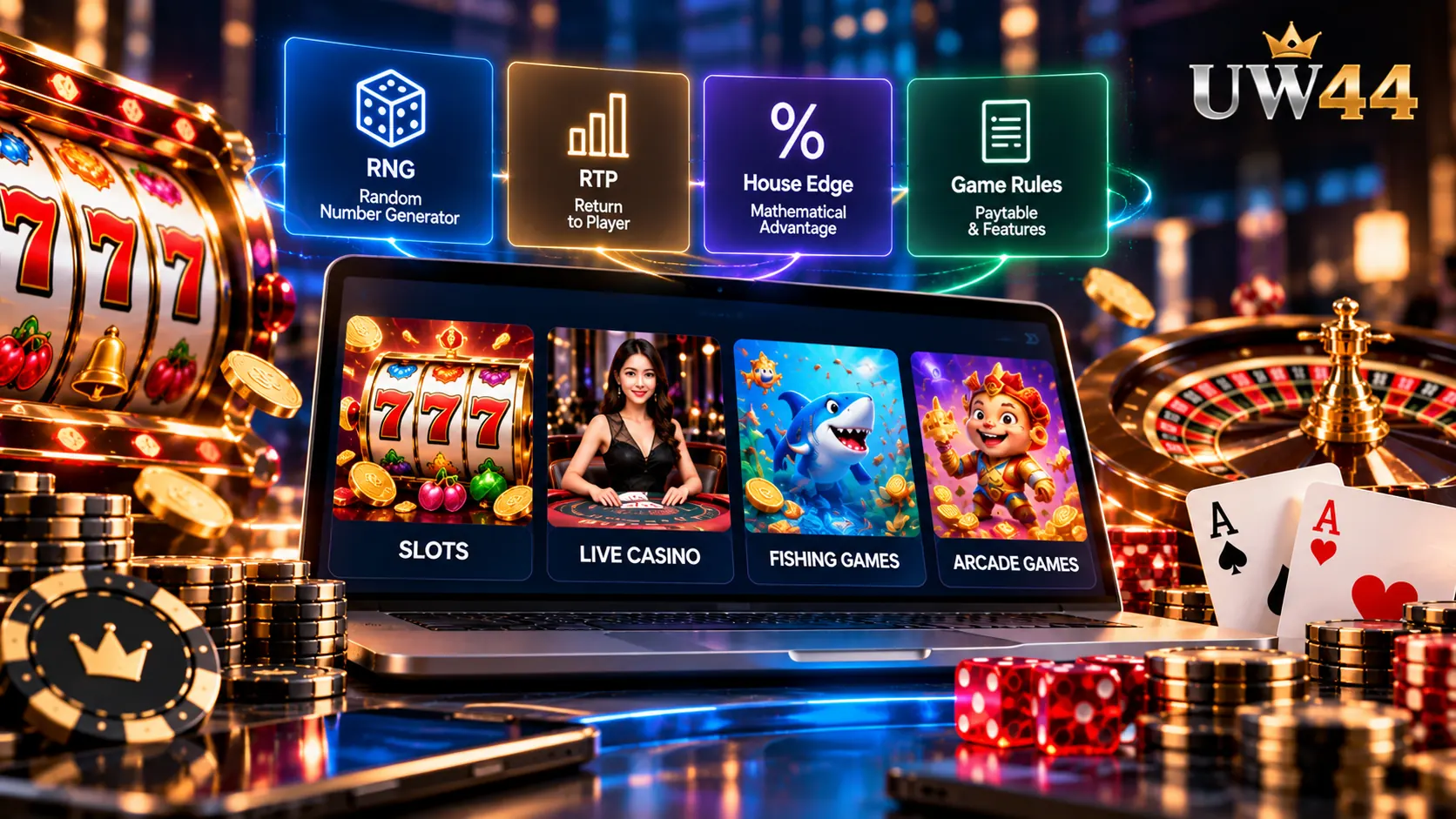
A slot machine and a live blackjack table can appear side by side on an online casino website, yet the technology behind them is quite different.
One produces results through software. The other may involve a real dealer, physical cards and a live video stream. Even games that look similar can use different rules, payout structures and methods for determining results.
So, how do online casino games work, and what actually happens between pressing a button and seeing an outcome?
This guide looks behind the interface to explain the technology, mathematics and game mechanics involved. It also covers the differences between slots, live casino, fishing games and arcade-style casino entertainment.
What Happens When You Start an Online Casino Game?
The process depends on the type of game, but a typical software-based casino game follows several steps.
- The player selects an available game and reviews its rules.
- The game receives an eligible action, such as a spin or a bet.
- Its software determines an outcome according to the game's programmed rules.
- The interface displays the result.
- Any applicable payout is calculated using the game's rules and paytable.
The animation is what players see. The underlying software and game mathematics determine how the result is produced.
For example, a slot game might display reels spinning for several seconds. That visual sequence does not necessarily mean the game is deciding its outcome throughout the animation.
In many RNG-based slots, the outcome is determined by the game software independently of the reel animation.
Random Number Generators: The Technology Behind Many Casino Games
A random number generator, or RNG, is a system used to produce values that determine game outcomes.
In many digital casino games, a software-based RNG selects results according to the game's mathematical design.
A slot machine, for instance, can use generated values to determine which symbols appear on its reels.
The important point is that a properly functioning RNG-based game does not need to remember whether the previous spin won or lost.
Can Previous Results Predict the Next Spin?
Consider this example:
A slot produces ten consecutive losing spins.
Does that mean the eleventh spin is more likely to win?
Not necessarily.
In a game where outcomes are independent, previous results do not make a future winning outcome more likely.
This is why claims about guaranteed winning patterns or a machine being “due for a payout” should be treated cautiously.
Does Every Online Casino Game Use an RNG?
No.
Many digital slots and virtual table games rely on RNG technology, but live dealer games operate differently.
Some arcade-style and fishing games also use distinct combinations of software rules, player inputs and outcome calculations.
Understanding the game category is the first step toward understanding its mechanics.
RTP and House Edge: Two Numbers Worth Understanding
Casino games are designed around mathematical rules. Two commonly discussed concepts are return to player and house edge.
Return to Player (RTP)
RTP represents the theoretical proportion of wagers a game is designed to return to players over a very large number of plays.
For example, a slot with a theoretical RTP of 96% is designed to return RM96 for every RM100 wagered across a sufficiently large volume of play, on average.
That does not mean an individual player will receive RM96 after wagering RM100.
Actual short-term outcomes can differ substantially.
House Edge
House edge describes the operator's theoretical mathematical advantage in a game.
For a simple game with a 96% theoretical RTP, the corresponding theoretical house edge is 4%, assuming the two figures are defined on the same basis.
However, different games can use different payout structures, rules and calculations.
A Simple Comparison
| Concept | What it describes | What it does not guarantee |
|---|---|---|
| RTP | Theoretical long-term return | An individual player's return |
| House edge | Theoretical mathematical advantage | A fixed loss on every session |
| Volatility | How wins and losses may be distributed | When the next win will occur |
| Hit frequency | How often qualifying winning outcomes occur | Whether those wins are profitable overall |
These figures are useful for understanding a game's design, but none can predict an individual session's result.
Why Slots and Live Casino Games Work Differently
Although both belong to online casino entertainment, slots and live dealer games create outcomes in different ways.
Online Slots
Digital slot games typically use software-based outcome generation.
Their mechanics can include paylines, symbol combinations, wild symbols, scatter symbols and bonus rounds.
Some slots use fixed paylines, while others use alternative ways-to-win systems.
The rules and paytable determine which outcomes qualify for payouts.
For readers interested in a more detailed explanation of slot formats and terminology, see the UW44 guide to online slot games in Malaysia.
Live Casino Games
Live casino games typically use video streaming to connect players with a real dealer or presenter.
Depending on the game, physical cards, roulette wheels or other equipment may be used.
The outcome is produced through the relevant game procedure, while the digital interface allows eligible participants to submit bets and view results.
Live baccarat, roulette and blackjack illustrate how different game rules operate within a live dealer environment.
Unlike an RNG slot, a live blackjack game may also involve player decisions that affect the mathematical outcome.
Learn more in the UW44 live casino Malaysia guide.
What About Fishing and Arcade Casino Games?
Fishing and arcade-style casino games often have more interactive interfaces than traditional slots.
Players may control aiming, timing or other on-screen actions.
However, the appearance of greater interaction does not necessarily mean that skill determines every result.
The relationship between player input and game outcomes depends on the individual game's design.
Some games may combine interactive mechanics with programmed payout rules or chance-based elements.
This makes it important to review the rules of each game rather than assuming that all fishing or arcade titles operate alike.
Four Game Categories Compared
| Game category | Typical gameplay | Main consideration |
|---|---|---|
| Slots | Reels, symbols and bonus features | Paytable, RTP and volatility |
| Live casino | Dealer-led table games | Game rules, odds and betting decisions |
| Fishing games | Interactive targeting mechanics | Game-specific rules and outcome systems |
| Arcade games | Varied interactive formats | Rules, costs and payout conditions |
These categories describe broad formats. Individual titles may differ significantly.
Five Common Myths About Online Casino Games
Misunderstandings often arise when players confuse visual effects with game mathematics.
Myth 1: A slot must pay out after a losing streak.
Independent game outcomes do not become more favourable simply because previous results were losses.
Myth 2: Playing at a particular time improves winning chances.
There is no general mathematical basis for believing that the time of day changes the odds of a properly functioning RNG game.
Myth 3: A high RTP guarantees frequent wins.
RTP concerns theoretical long-term returns, not the frequency or size of individual payouts.
Myth 4: Every live casino game has the same house edge.
Different games and rule variations can have different mathematical advantages.
Myth 5: Interactive games are always skill-based.
An interactive interface does not establish that outcomes depend entirely on skill.
What Should You Check Before Playing a Game?
A game's appearance may attract attention, but its published information is more useful for understanding how it works.
Look for the following details:
- Game rules: How outcomes are determined and what actions are available
- Paytable: Which outcomes qualify for payouts
- RTP information: Whether a theoretical return is disclosed
- Bet limits: Minimum and maximum permitted amounts
- Bonus mechanics: How additional features are activated
- Game restrictions: Any special eligibility or promotional conditions
Where independent testing or certification is claimed, the claim should be supported by verifiable information about the testing organisation and the game version concerned.
A polished interface is not proof that a game has been independently tested.
Understanding Game Categories at UW44
UW44 presents several online casino entertainment categories, including slots, live casino, fishing games and arcade games.
Each category involves different gameplay conventions and technical considerations.
The UW44 homepage provides an introduction to the platform, while the games section organises the available categories.
The presence of a game on a platform does not, by itself, establish its RTP, fairness certification or regulatory status. Those details require game-specific verification.
Frequently Asked Questions
How do online slot machines decide winners?
Many online slots use random number generation and programmed paytables to determine results. The specific implementation depends on the game.
Can online casino games be predicted?
A properly functioning RNG-based game with independent outcomes cannot reliably be predicted using previous results.
Is RTP the same as a winning percentage?
No. RTP is a theoretical long-term return measure. It does not describe the probability that an individual session will be profitable.
Are live casino games controlled by computers?
Live casino games typically use real dealers or physical game equipment, supported by streaming and digital betting systems. Their precise operation varies by title.
Are fishing games based entirely on skill?
Not necessarily. Their mechanics depend on the individual game's rules and software design.
Does a higher bet improve the chance of winning?
Increasing a wager does not automatically improve the underlying probability of a winning outcome. The effect depends on the game's specific rules.
Final Thoughts
Online casino games may share a similar digital interface, but the systems behind them can be very different.
RNG-based slots rely on software-driven outcome generation. Live dealer games involve real-time game procedures. Fishing and arcade titles may combine interactive controls with their own programmed mechanics.
Understanding these differences, along with RTP, house edge and game rules, provides a more accurate picture of how online casino entertainment operates.
Responsible Gaming: Gambling outcomes are uncertain, and losses are possible. Gambling is subject to applicable laws and age restrictions. No game system or strategy guarantees a profit.
About the Author
Jason Tan
UW44 Online Casino Guides
Jason Tan is credited as the author of this educational guide about online casino game mechanics, mathematical concepts and gameplay formats.
Author Profile: LinkedIn